Motorsport
A History of the World Rally Championship
The World Rally Championship (WRC) stands as motorsport’s ultimate test of man and machine. Unlike circuit racing

The Evolution of Speed: A History of the World Rally Championship
The World Rally Championship (WRC) stands as motorsport’s ultimate test of man and machine. Unlike circuit racing, where drivers memorise every turn on a smooth sheet of asphalt, rally drivers race against the clock on narrow mountain passes, icy forest tracks, and sun-baked gravel trails. Governed by the Fédération Internationale de l’Automobile (FIA), the WRC has spent over half a century pushing automotive technology to its absolute limits.
1973–1981: The Early Years and Group 4
The FIA officially launched the World Rally Championship in 1973. Prior to this, international rally events operated independently or under smaller regional series. The inaugural 1973 season brought together iconic events—including the historic Rallye Monte-Carlo and the gruelling East African Safari Rally—into a single manufacturers’ championship.
The early era was dominated by rear-wheel-drive machines operating under Group 4 regulations. Alpine-Renault captured the first manufacturers’ title in 1973 with the lightweight A110. Soon after, Lancia unveiled the Stratos HF—the first vehicle engineered purely for rallying rather than adapted from a standard road car.
In 1979, the FIA introduced the Drivers’ Championship, awarding the inaugural title to Sweden’s Björn Waldegård. The decade closed with balanced competition among iconic production-based models like the Ford Escort RS1800 and the Fiat 131 Abarth.
1982–1986: The Legendary Group B Era
In 1982, the FIA introduced Group B regulations. Designed to encourage manufacturer entry by requiring a production run of just 200 road-going units, Group B unleashed an era of unprecedented speed, power, and engineering.
Audi revolutionised the sport by introducing all-wheel-drive technology via the Audi Quattro. Four-wheel drive instantly made traditional rear-wheel-drive setups obsolete on loose surfaces. Mid-engined monsters quickly followed, including the Peugeot 205 T16 and the Lancia Delta S4. Lightweight composite bodywork, advanced turbocharging, and high-downforce aerodynamics pushed engine outputs past 500 horsepower.
However, safety regulations failed to keep pace with performance. Tragic incidents involving spectators and drivers—most notably the fatal crash of Henri Toivonen and co-driver Sergio Cresto at the 1986 Tour de Corse—prompted the FIA to ban Group B at the end of 1986.
1987–1996: Group A and the Japanese Golden Era
Following the cancellation of Group B, the FIA mandated Group A as the top tier. Group A enforced stricter homologation rules, requiring 2,500 production models. This shift reconnected rally cars directly to the showroom floor.
Lancia dominated the early Group A era. The Lancia Delta HF Integrale secured six consecutive manufacturers’ titles from 1987 to 1992—a record that stands today.
By the 1990s, Japanese manufacturers rose to prominence. Toyota, Subaru, and Mitsubishi built iconic high-performance four-wheel-drive production cars. Drivers like Carlos Sainz (Toyota), Colin McRae (Subaru), and Tommi Mäkinen (Mitsubishi)—who claimed four straight drivers’ titles from 1996 to 1999—turned rallying into a global television phenomenon.
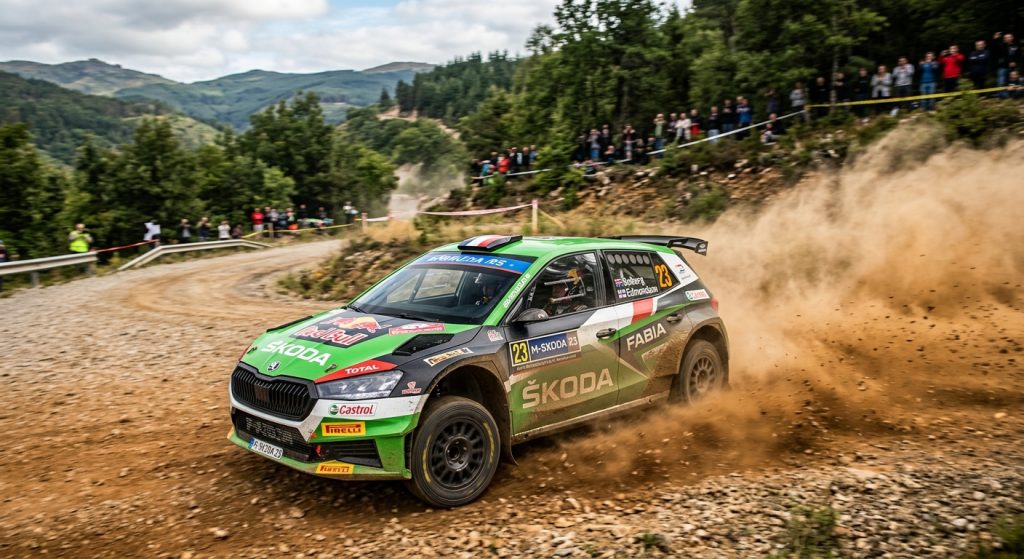
1997–2021: The World Rally Car Era
To encourage broader manufacturer participation without requiring expensive performance road cars, the FIA introduced the “World Rally Car” (WRC) regulations in 1997. Manufacturers could now transform standard front-wheel-drive hatchbacks into four-wheel-drive rally machines.
This period saw entry from brands like Peugeot, Citroën, Ford, Hyundai, and Volkswagen. It also gave rise to two of the most dominant drivers in motorsport history:
- Sébastien Loeb: Won an unprecedented nine consecutive Drivers’ Championships with Citroën between 2004 and 2012.
- Sébastien Ogier: Secured eight Drivers’ Championships across three different manufacturers (Volkswagen, Ford, Toyota) between 2013 and 2021.
Updated technical rules in 2017 allowed for wilder aerodynamic wing packages and 380-horsepower engines, creating some of the fastest rally cars ever built.
2022–Present: The Rally1 Hybrid Era
In 2022, the WRC entered a new technological era with the introduction of Rally1 regulations. Designed to align motorsport development with modern automotive trends, Rally1 vehicles feature a standardised 100 kW plug-in hybrid system paired with a 1.6-litre turbocharged engine. Combined, these cars generate over 500 horsepower in short bursts using 100% sustainable fuel.
Safety was also overhauled with a standardised steel space-frame safety cell replacing traditional modified production shells.
Summary of Key Eras
| Era | Key Technical Rule | Notable Cars | Iconic Drivers |
| 1973–1981 | Group 4 (Rear-Wheel Drive focus) | Alpine A110, Lancia Stratos, Ford Escort RS1800 | Björn Waldegård, Sandro Munari, Walter Röhrl |
| 1982–1986 | Group B (AWD, Turbocharged, >500 hp) | Audi Quattro, Peugeot 205 T16, Lancia Delta S4 | Hannu Mikkola, Ari Vatanen, Stig Blomqvist |
| 1987–1996 | Group A (Strict Production Homologation) | Lancia Delta Integrale, Subaru Impreza, Mitsubishi Lancer Evo | Juha Kankkunen, Colin McRae, Tommi Mäkinen |
| 1997–2021 | World Rally Car (Custom AWD/Aero on standard shells) | Peugeot 206 WRC, Citroën C4 WRC, Toyota Yaris WRC | Sébastien Loeb, Sébastien Ogier, Marcus Grönholm |
| 2022–Present | Rally1 (100 kW Hybrid + 1.6L Turbo, Sustainable Fuel) | Toyota GR Yaris Rally1, Hyundai i20 N Rally1, Ford Puma Rally1 | Kalle Rovanperä, Ott Tänak, Thierry Neuville |