F1
What Do All Those Buttons Do? Decoding the F1 Steering Wheel
If you’ve ever caught an onboard camera shot during a Formula 1 Grand Prix, you’ve probably noticed the driver’s hands flying across a steering wheel

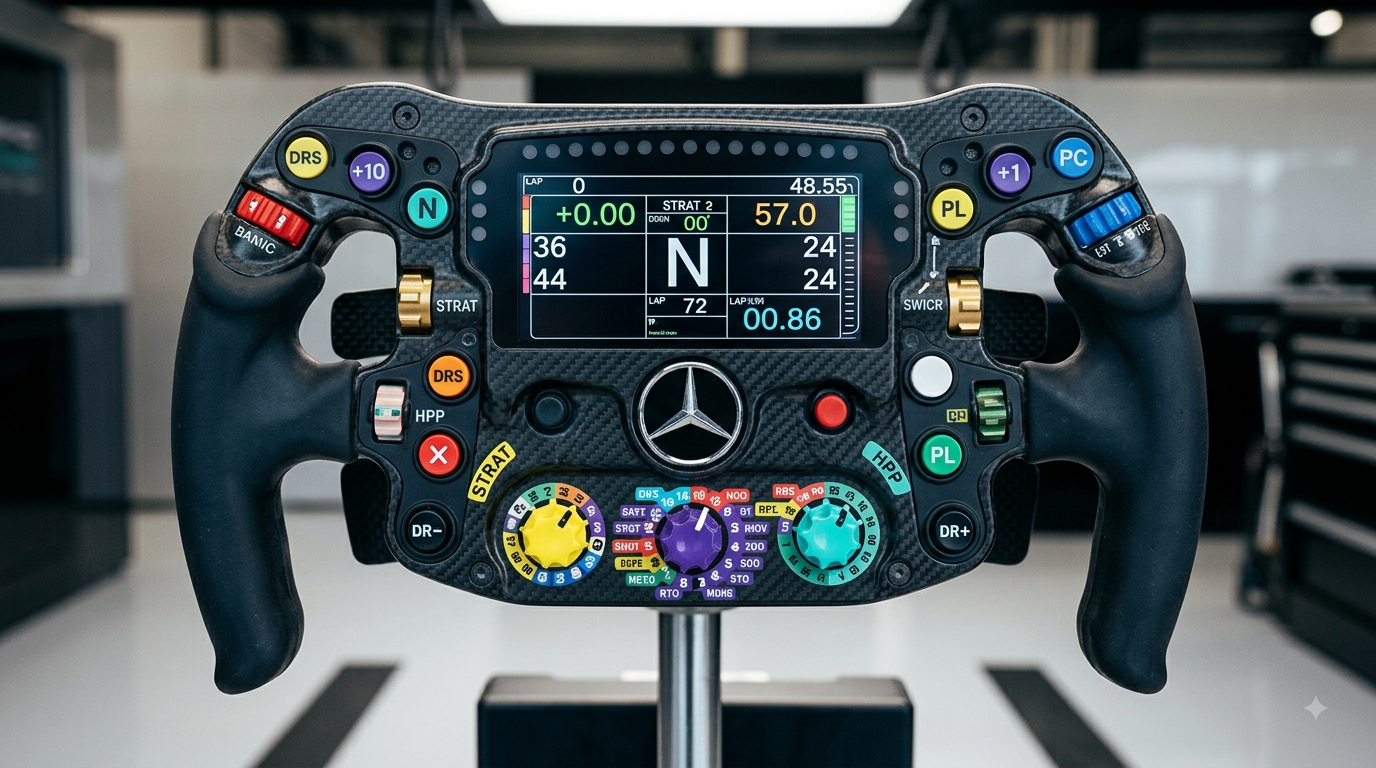
If you’ve ever caught an onboard camera shot during a Formula 1 Grand Prix, you’ve probably noticed the driver’s hands flying across a steering wheel that looks less like traditional car controls and more like an arcade game controller merged with a jet fighter dashboard.
With custom carbon fiber construction and price tags reaching upwards of £50,000 to £100,000, an F1 steering wheel isn’t just a directional control—it’s the nervous system of a modern Formula 1 car.
Let’s take a look at what actually happens on that tiny piece of real estate while drivers hurtle around track corners at over 200 mph.
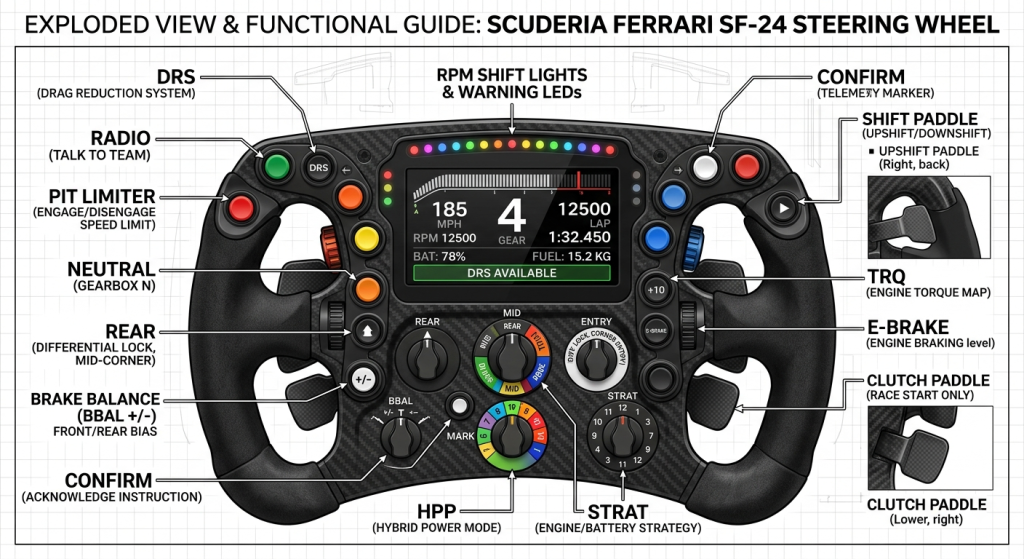
1. The Command Center: Central OLED Display & Shift Lights
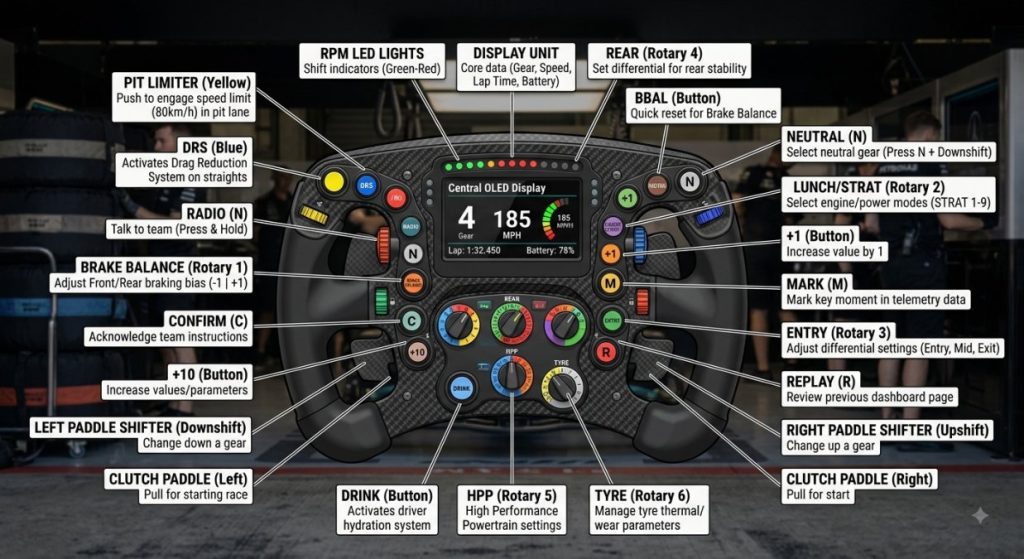
Right at the top of the wheel sits a row of bright LEDs. These are the RPM shift lights, indicating the optimal time to gear up.
Directly below is the digital OLED display, providing real-time telemetry, including:
- Current Gear & Speed
- Lap Times & Delta (how much faster or slower they are compared to their best lap)
- Battery Charge Level (ERS)
- Tyre Temperatures & Pressures
2. On-the-Fly Performance: The Rotary Switches
Located near the bottom and center of the wheel, these dials allow drivers to change how the car behaves without pulling into the pit lane.
| Switch / Dial | Primary Function |
| STRAT (Engine Mode) | Controls engine mapping and hybrid deployment modes (e.g., qualifying pace vs. saving fuel/battery). |
| HPP (Power Unit) | Adjusts specific settings for the internal combustion engine and energy recovery systems. |
| DIFF (Differential) | Fine-tunes how power is distributed between the rear wheels upon entry, apex, and exit of a corner. |
| BBAL (Brake Balance) | Shifts braking force toward the front or rear to account for tyre wear and fuel burn. |
3. High-Speed Buttons: Instant Access
When seconds count, drivers use thumbs and fingers to hit key buttons without taking their hands off the grips:
- DRS (Drag Reduction System): Opens the rear wing flap on designated straights to cut drag and boost speed for overtaking.
- Pit Limiter: Enforces the strict speed limit (usually 80 km/h) when entering the pit lane to avoid penalties.
- Radio (Push to Talk): Connects the driver directly to their race engineer for strategy updates.
- Charge / Overtake: Instantly deploys maximum energy from the battery system for extra horsepower.
- Mark / Confirm: Allows the driver to flag a specific timestamp in telemetry data for engineers to analyse after the session.
- Drink: Operates a small pump that delivers fluid through a tube in the driver’s helmet!
4. Behind the Wheel: The Paddles
Flip the wheel around, and you’ll find the tactile controls operated by the driver’s fingertips:
- Gearshift Paddles: Left paddle for downshifting, right paddle for upshifting.
- Clutch Paddles: Used almost exclusively for the race start to control bite-point engagement and launch off the grid.
Summary
At racing speeds, managing a modern F1 car requires incredible multitasking. Drivers aren’t just steering; they are running a mobile control center while pulling several Gs in G-force. Next time you watch a race onboard, keep an eye out for those quick thumb flicks—they might just be setting up the pass of the race!